How well am I asserting myself?
 It is an increasingly competitive world. We need to assert our wants and desires in order to thrive. It is also an increasingly (socially) distant world, and not just because of a pandemic. It is easy to get distracted by the limited connections provided by social media, and not have the richer experience of direct interaction with others. To connect with others we need to be comfortable revealing ourselves.
Considerations when answering the question, “Am I asserting myself?”
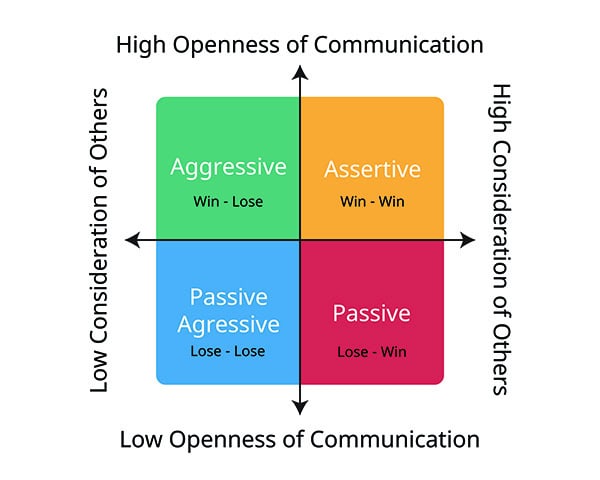
Assertiveness is the direct expression of my experience and reactions, including my thoughts, beliefs, opinions, emotions, and the like, while recognizing that others may have (and have a right to) different experiences and reactions. Assertiveness is a mean between aggressiveness and passivity. I am aggressive if I express myself or act for myself, without considering the presence and rights of others. I can drive people away by being aggressive. On the other hand, I am passive if I do not express myself. My experiences and thoughts are not included in discussion and decision making because they have not been heard. I can later resent being ignored.
See also: Managing Interpersonal Boundaries, pt. I
There are many challenges associated with being assertive. Many of us fear that directly expressing ourselves may lead to conflict with others, who will to some degree have different thoughts, beliefs, and so forth. If we give in to this fear then we have relationships with people who do not actually know us. They know only what we have shown of ourselves. We can express ourselves indirectly, perhaps passive-aggressively, which also keeps others at a distance. On the other hand, we may over-express ourselves, perhaps in the wrong time or place, and come across as self-focused or aggressive.
By being assertive we do not expect others to read our minds, and we also convey our recognition that our perspectives are not the only ones possible. By being assertive we establish the possibility of genuine negotiation, deep communication, and lasting collaboration: Real connection.
You might also be interested in: Managing Interpersonal Boundaries, pt. I