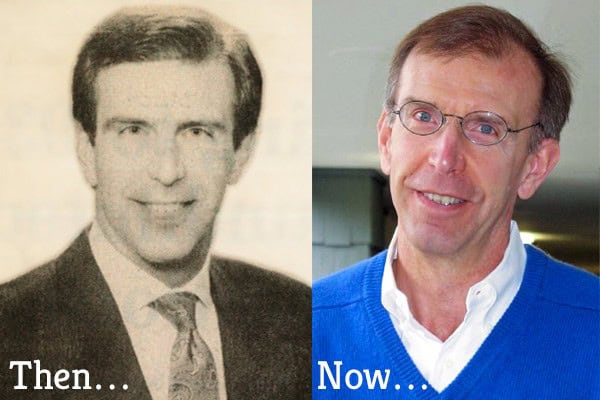
 As I reflect over the 30 years since Practical Recovery’s beginning, I realize it has been quite a journey! What started as one man (me) in private practice, working to provide quality addiction treatment, has become an entire team of passionate and caring individuals who are seeking to lead a movement to change the country’s perspective on addiction treatment.
The Early Years
My journey started in 1985 when I began specializing in addiction treatment. I realized then that if I ever personally had addiction problems, the 12 steps and the disease model would not help me. They did not make sense to me. I had worked a rotation at an inpatient addiction facility and had spent three years as a Navy psychologist seeing sailors with alcohol problems. These experiences convinced me that the standard US model did not benefit everyone. My clients acknowledged substance problems but would not attend AA. I set out to learn what might help them.
The first ten years were especially difficult. Some addiction colleagues met me with extreme resistance. In 1986 I was the guest speaker at the San Diego NCADD breakfast, at the invitation of the courageous local executive director. I believe that if the audience had had access to rotten fruit and vegetables I would have been covered with them! Repeatedly over the years, addiction professionals have had trouble understanding what I’ve been saying. The solid scientific evidence behind my positions has been ignored, often with no explanation at all, or with the comment that it is irrelevant. Yet day after day clients were telling me about their frustrations in standard treatment and how happy they were to find an alternative. So, I journeyed on. By 1995 I was hired for consulting positions at two local hospitals, a sign of significant progress!
Over the next few years I spent as much time learning about addiction as my busy practice would allow. My clinical experience and observations inspired me to publish the first edition of Sex, Drugs, Gambling & Chocolate: A Workbook for Overcoming Addictions in 1999, and a second edition in 2003. I wrote the majority of the book in eight very long days and it was one of the peak experiences of my life!
At about the same time the workbook was published, I began using the name Practical Recovery (formerly New Horizons). The website practicalrecovery.giriinternational.in/ was established and I started hiring professional staff. Clients began coming from around the US and even other countries. I could see that we were providing an approach that was meaningful to many people and lives were being changed. An appreciation for a self-empowering approach had taken root and would continue to grow.
The Self-Empowering Approach and the Many Roads to Recovery
What is a self-empowering approach? In self-empowering recovery the goal is to gain power, ability and capacity, in order to make better recovery and life decisions. It views the capacity to overcome addiction as residing within the individual. Is this approach better than a powerlessness approach? Not necessarily better, but certainly equal to. For about half the population I believe it is a better fit. I expect that research will establish this over time.
In addition to making the self-empowering approach widely available, my journey has helped me define my passions. First, I am passionate about spreading the message that addictive behavior is common to all. Addictive behavior is essentially survival behavior. The so-called “addicts” in our midst are not fundamentally different from the rest of us. It’s important to me that we change our language about problematic addictive behavior by removing the labels of “disease,” “addict,” “alcoholic” and related terms. Public health messages need to speak in less stigmatizing terms. It is ironic that the traditional recovery community wants to eliminate stigma, yet adopts language that promotes it.
Second, I am passionate that the world recognizes that there are truly as many roads to recovery as there are individuals. The point of treatment is to help the individual find his or her road and not to withdraw support and services when that road goes sideways or backwards at times. I regularly witness how the self-empowering path ultimately leads to passionate, meaningful and resilient lives for our clients, who in many cases move on from problematic addictive behavior altogether. Let’s be honest, if the standard path works so well for everyone, why do we still have so many addiction problems?
Third and finally, I am passionate about my team. My passion is fueled by my deep commitment to my colleagues at Practical Recovery. I aim to lead a company where all staff can pursue a fair balance between life and work that aligns with Practical Recovery’s mission. We now number about 40. For many of us it will be a long-term position. In my own case I plan to die on this journey “with my boots on.” And I can’t think of a better group of people to be along side me.